The Battle of Vertières: Descendant of Revolution
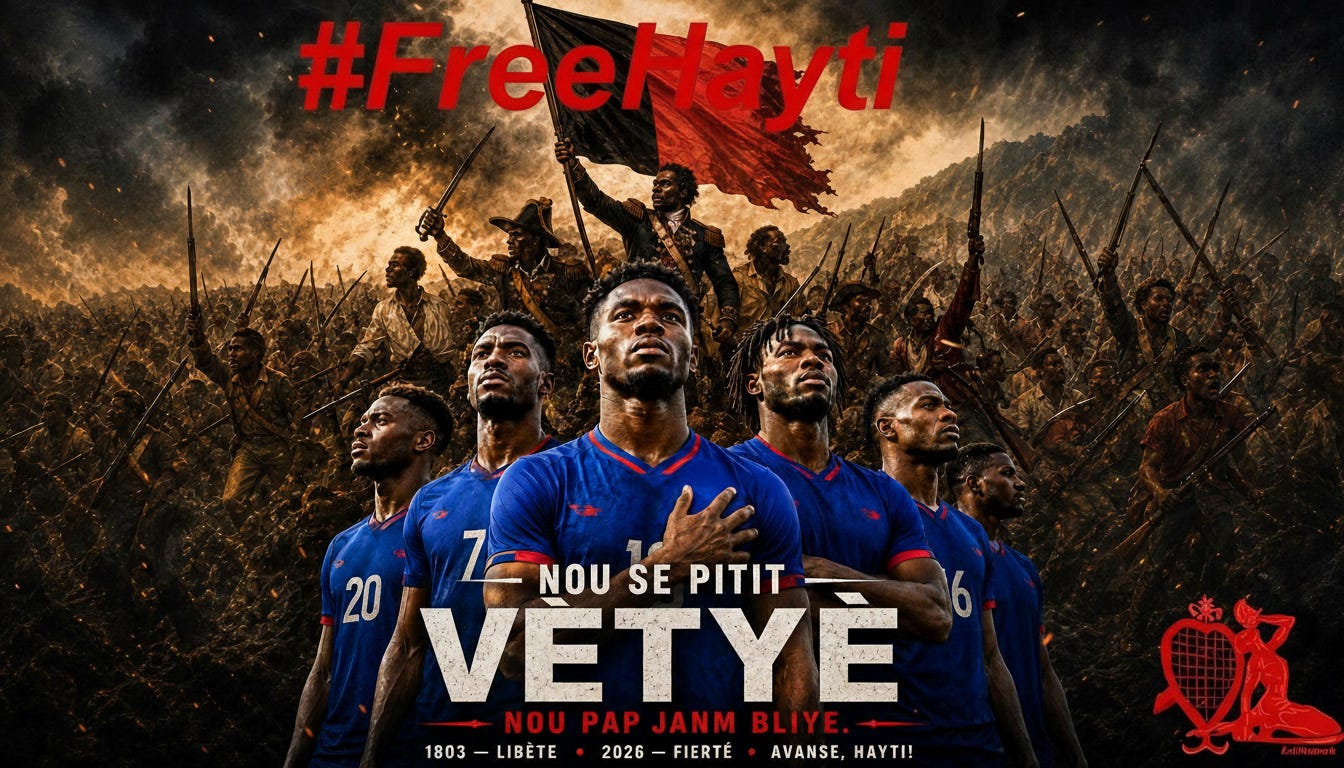
This section of TOYA’s world is where history, memory and present reality, collide.
I was minding my own business, writing the next episode of TOYA!—charting for Season One, how Makandal, Toya, and the Dede Society laid the clandestine groundwork for revolution in 1757—when FIFA decided, right before the first game, to holler for the attention of Black folks. They issued a very last-minute ruling stating that the Hayti World Cup soccer team jersey artwork violated their rules about not being “political.”
FIFA’s ruling points to a facially neutral equipment rule barring “political, religious, or personal” messages. But the plausible deniability of these white folks sits at what FIFA chooses to police—and arbitrarily classify—as “political.”
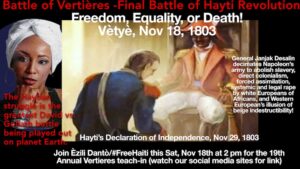
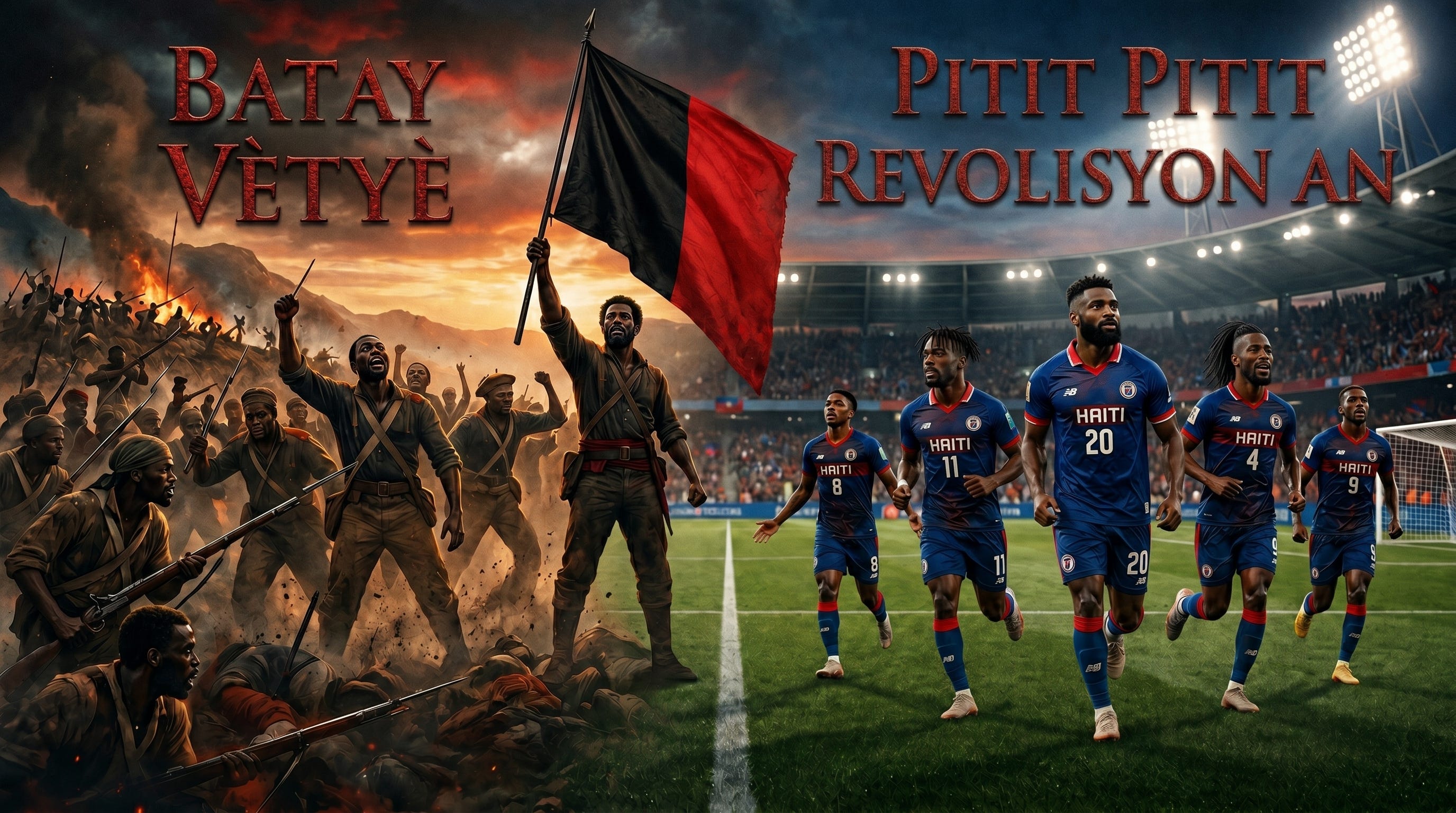
The rejected image did not promote a modern party, a candidate, a current war, or a policy demand. It commemorated the decisive 1803 Battle of Vètyè (Vertières in English)—the direct culmination of the Hayti Revolution I am writing about in TOYA: The Warrior Who Raised An Empire.

Vètyè is the battle that secured Haytian independence, stopped forced assimilation, shattered the Triangular Trade, and forever abolished slavery. The design honored and celebrated Haytian national pride and resilience rather than advancing a political statement. But bullying Hayti is the Internationals’ most fervent pastime.
That classification of heritage as “political” says far more about FIFA’s racism than it does about Hayti’s choice of jersey art. The team naturally recalled Vètyè because the Grenadiers qualified for the World Cup last year on November 18, 2025—the exact anniversary of the Battle of Vertières (Batay Vètyè). It is a day Haytians honor every single year.
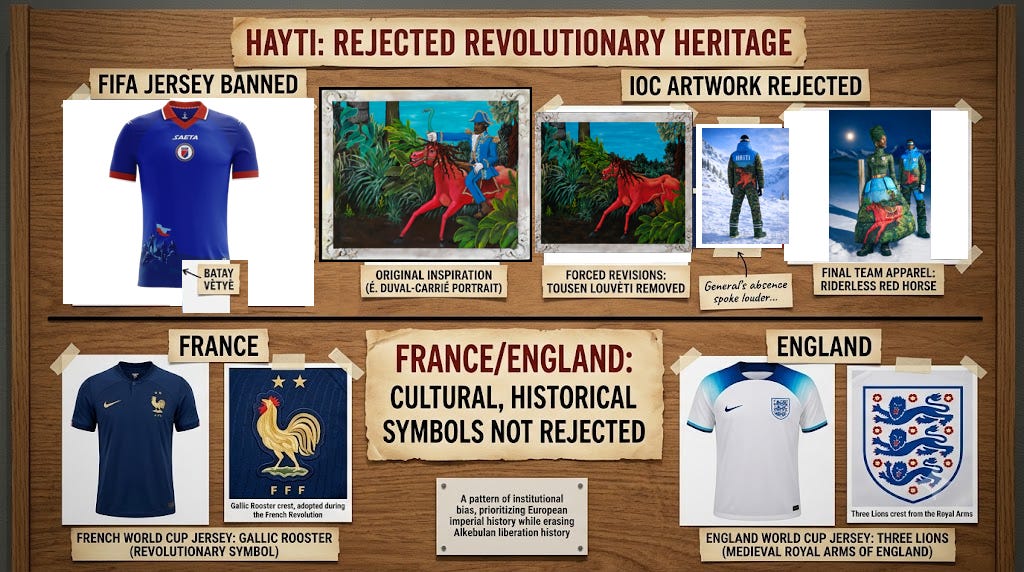
The institutional consistency of the heirs and defenders of the slavery system was also evident earlier this year when the International Olympic Committee forced Hayti’s two-person Olympic team to change the artwork for the 2026 Winter Olympics because it was too “political.” The team was forced, at the last minute, to remove the image of General Toussaint Louverture charging on a red horse from its Olympic uniforms. Erasing Hayti heroes and minimizing the Hayti Revolution is a constant preoccupation of the colonizers.
As with the FIFA ruling, the IOC delivered its capricious decision late in the process, limiting the time available for public reaction, making it a fait accompli. The designer, Stella Jean, who based her design on a painting by Edouard Duval-Carrié, worked frantically with her team, repainting the uniforms by hand to deliver them in time for the opening ceremony. The Hayti Winter Olympic team walked into the opening ceremony wearing a riderless horse, proving that, even when they try to erase the history, the forced absence becomes its own indictment. As Stella Jean said of Tousen: “His absence speaks louder than his presence would have.
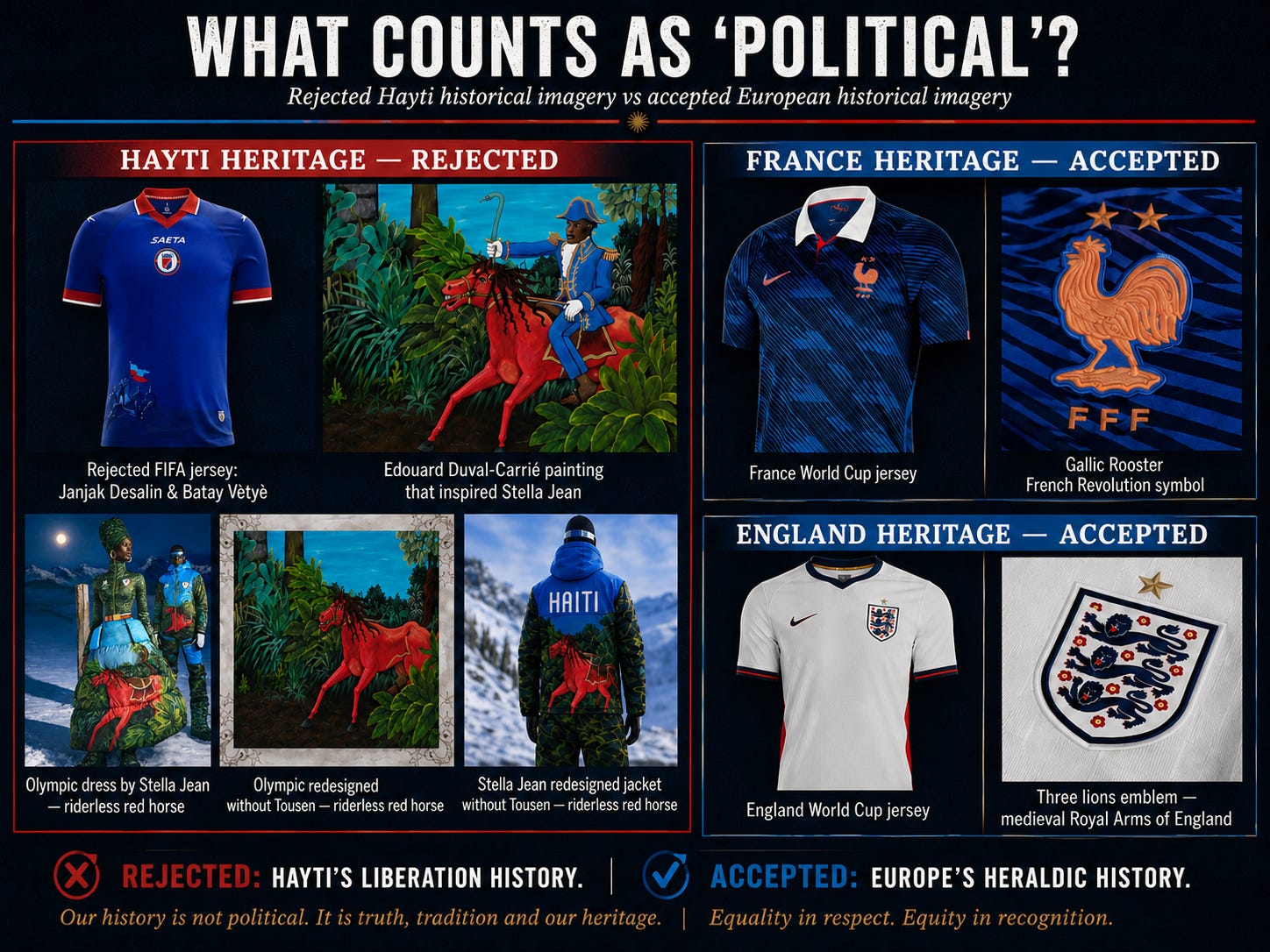
Photo caption: FIFA seemed to have approved the 2026 Hayti design by uploading it in their shop, then banned the history 24 hours before the game. The rejected Hayti jersey is still on the FIFA’s online shop. The Hayti team took the field, a mere 24-hours after learning their national memory had to be removed from their jersey kit.
By the time FIFA prohibited the Vètyè imagery, the original jersey had already sold out. It had been publicly promoted, photographed, displayed for sale, and worn by the team during friendly matches. The public had already embraced the design as a celebration of Haytian history, national pride, and survival. FIFA intervened only after that history had already spoken for itself.
Hayti World Cup players on June 13, 2026 at friendly pre-game with the subsequently rejected Vètyè shirt.
FIFA’s ruling evidences a glaring double standard. It becomes impossible to defend when other countries are permitted to carry historic and national symbolism without penalty:
- France’s national team plays every single match with the Gallic Rooster on their chests—a symbol that was explicitly adopted during the French Revolution to represent the power of the French state. Their revolutionary history is celebrated as their permanent crest.
Every single time the French national team takes the pitch, they are wearing a symbol of their revolution on their chests. But FIFA tells Hayti’s soccer team it cannot wear an image of their revolution? - Mexico’s celebrated World Cup designs have incorporated the Aztec Sun Stone and pre-Hispanic imagery to showcase national history.
- 1998 World Cup: Their green home kit (produced by ABA Sport) famously featured a massive, sublimated watermark of the Aztec Sun Stone (Piedra del Sol) across the entire chest. It is considered one of the most iconic World Cup kits of all time.
- 2022 World Cup: Their away kit (by Adidas) prominently featured Mixtec art and the serpent deity Quetzalcoatl to summon the “fighting spirit” of their ancestors.
- 1998 World Cup: Their green home kit (produced by ABA Sport) famously featured a massive, sublimated watermark of the Aztec Sun Stone (Piedra del Sol) across the entire chest. It is considered one of the most iconic World Cup kits of all time.
- The United States’ 2026 designs openly draw on the flag, stars, and earlier patriotic uniforms.
- 1994 World Cup: The infamous “denim” away kit was covered in giant white stars, directly mimicking the American flag.
- 2012 & 2014: The “Waldo” striped kits and the “Bomb Pop” kits heavily leaned into the red, white, and blue nationalism. The US Soccer crest itself is a shield of stars and stripes. Displaying the iconography of the American state (an empire) is entirely normalized.
- 1994 World Cup: The infamous “denim” away kit was covered in giant white stars, directly mimicking the American flag.
Those references are generally embraced as identity, culture, heritage, or national pride—never as prohibited politics.
FIFA’s claim of political neutrality becomes even more difficult to take seriously when its own president, Gianni Infantino, created and personally presented FIFA’s inaugural Peace Prize to Donald Trump, a sitting American president and one of the most politically divisive figures in the world. Apparently, placing FIFA’s institutional prestige behind a powerful politician is not too “political,” but allowing Haytian players to carry the memory of the men and women who defeated slavery is. FIFA may hide behind the technical distinction between a match-kit regulation and an official awards ceremony, but the contradiction remains: contemporary political power is honored on FIFA’s stage, while Hayti’s revolutionary ancestors are erased from its fabric. That is not neutral enforcement. It is selective enforcement shaped by power.
So the double standard is not simply that one shirt contained “history.” It is that the former colonizer’s history is normalized as culture, while the history of enslaved people overthrowing an empire is treated as political, dangerous, and out of bounds.
Vertières is not merely a generic battle scene. For Hayti, it is foundational national memory. To remove it from the uniform is to suggest that Hayti may display colors and symbols only after their revolutionary meaning has been emptied out. That fits a much longer pattern: Hayti’s liberation is praised abstractly, but its actual defeat of France, its abolitionist force, its Black military sovereignty, and its absolute refusal of colonial rule remain uncomfortable for the global establishment.
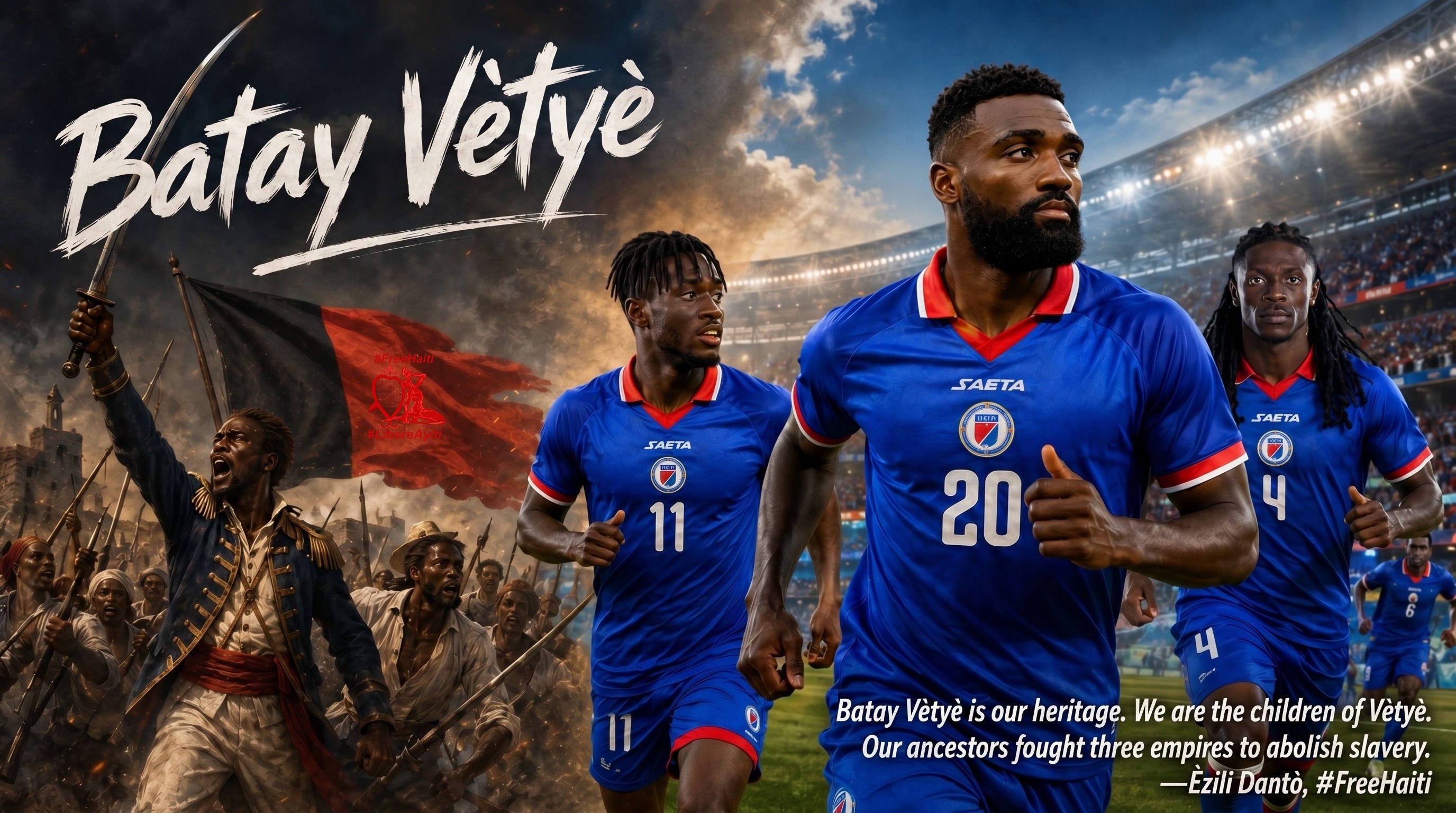
The Battle of Vertière is our legacy. We are the children of Vertière. Our ancestors defeated three empires to abolish slavery. —Èzili Dantò, HLLN & FreeHaitiMovement
Batay Vètyè se eritaj nou li ye. Nou se pitit Vètyè. Zansèt nou yo te bat twa anpi pou aboli esklavaj. —Èzili Dantò, HLLN & FreeHaitiMovement
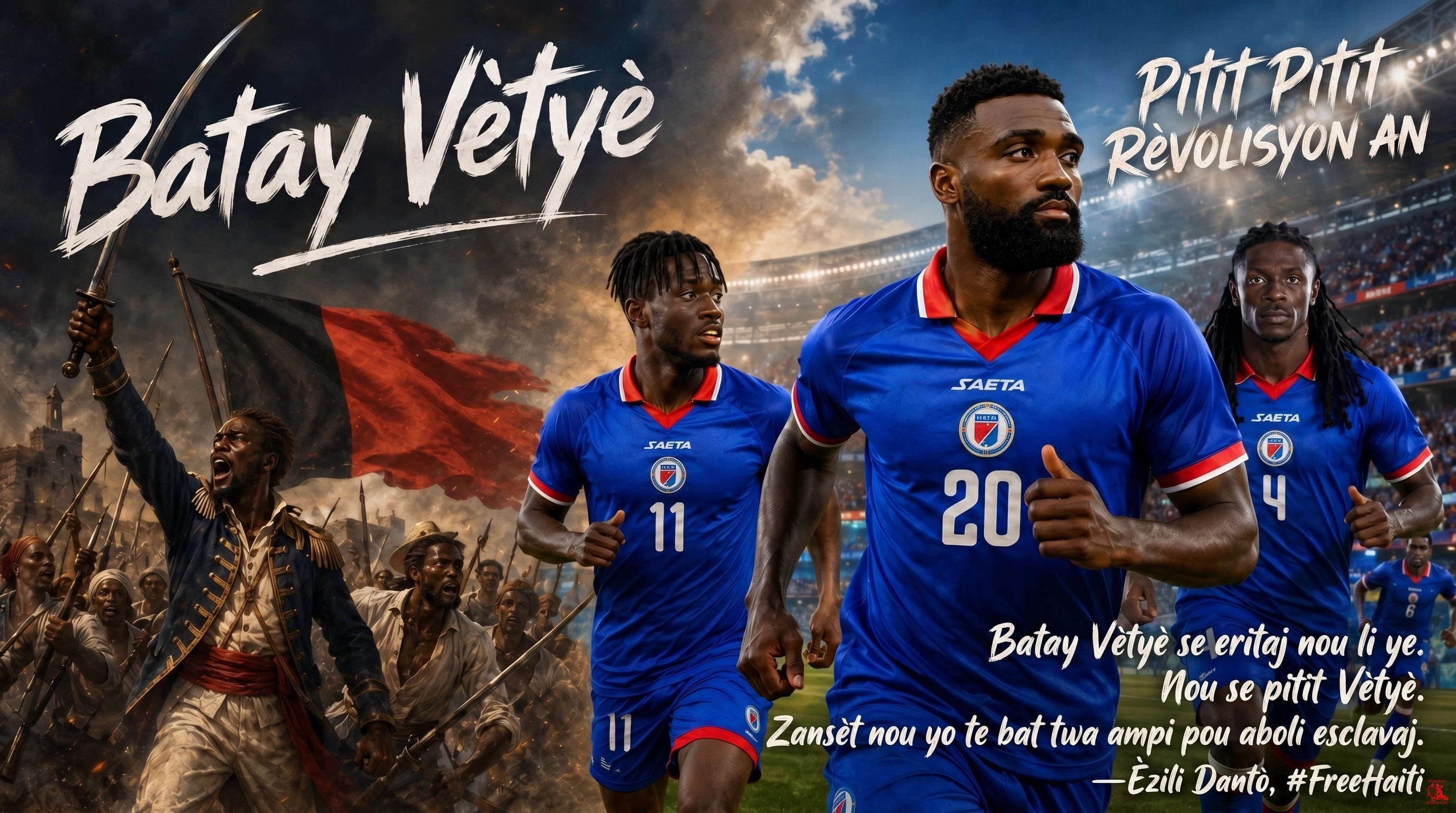
A national liberation victory should not become impermissible merely because the liberated people were Black and the defeated power was European.
But for Haytians, I am telling you, there is a profound exhaustion in constantly bracing against the colonizer’s many global apparatuses engineered to perpetually tilt the scales, ensuring no arena is ever truly neutral for Hayti.
As head of the #FreeHaitiMovement, I will always take the time to push back on the bullying of the Internationals regarding Hayti’s commemorative artwork.
Why is France’s imperial memory called heritage, while Hayti’s victory over enslavement is called politics? Bottom line: FIFA can order that the Battle of Vertières artwork be removed from the jersey kit. But they absolutely cannot remove Vertières from the people wearing it.
Here’s the transcript for the video above, both in standard Kreyòl and in English:
BATAY VÈTYÈ
NOU SE PITIT PITIT REVOLISYON AN
*
Batay Vètyè se eritaj nou li ye.
Nou se pitit Vètyè.
Zansèt nou yo te bat twa anpi pou aboli esklavaj.
*
The Battle of Vertières
We are the descendants of the revolution.
*
The Battle of Vertières is our legacy. We are the children of Vertières. Our ancestors defeated three empires to abolish slavery.
If you’re reading my TOYA series and want to understand the modern resonance of that fight—why this history isn’t safe or settled, the FIFA ruling is your evidence.
The good side effect of FIFA’s capriciousness and arbitrariness towards the Hayti team is that I see folks all over social media making videos and learning more about the Battle of Vertières, where Hayti beat Napoleon’s army. I suppose that’s the “sensitive political element?” Get over it! Hayti defeated Napoleon, England, and Spain to abolish slavery and gain its independence. That independence so bothers these slave-makers that they won’t even allow Hayti to simply enjoy a football game without policing our heritage.
Share your thoughts in the comment section on this: France is allowed to wear the symbol of its revolution, but when Hayti tries to honor the men and women who defeated that very same French empire, it is suddenly deemed “political.” Mexico celebrating its indigenous and ancient warrior history is marketed by the football world as “beautiful heritage,” whereas Hayti honoring its warrior history is penalized. Make it make sense.

Add a comment:
Powered by Facebook Comments